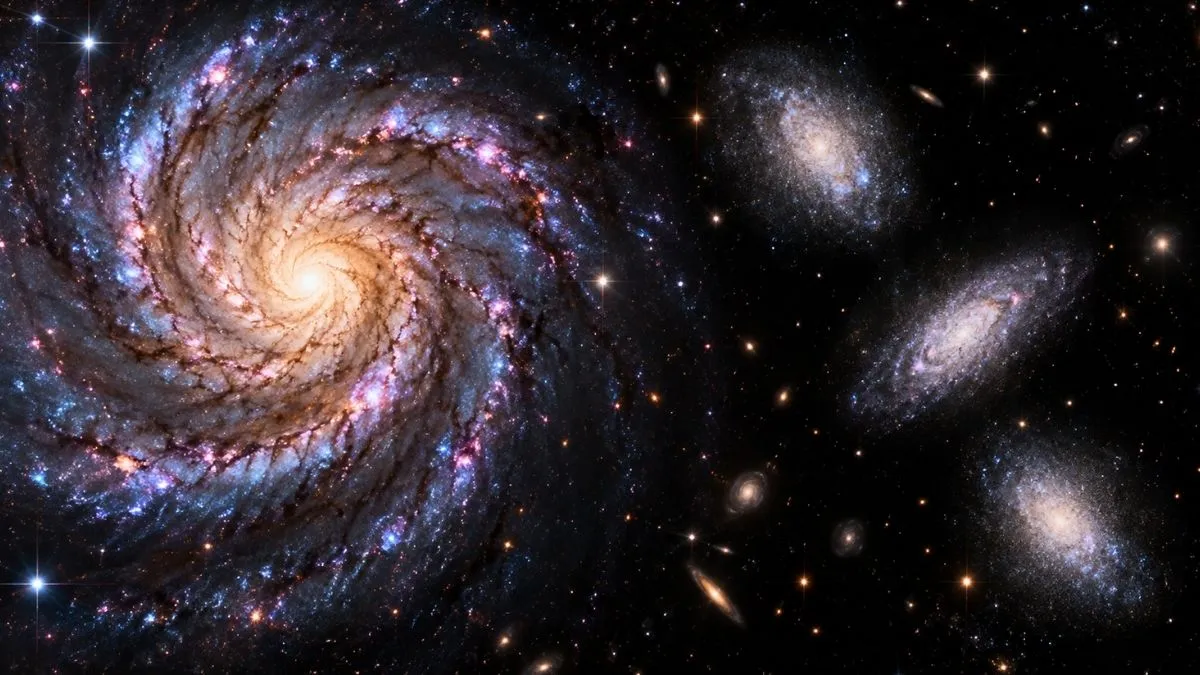
"Licealista odkrył trzy galaktyki. Astronomowie od dawna szukali wyjaśnienia. Licealista odkrył trzy galaktyki. Astronomowie od dawna szukali wyjaśnienia."
Polecane przez InfoHub
Nasze konta oszczędnościowe zapewniają atrakcyjne oprocentowanie i brak opłat za prowadzenie. Środki są dostępne 24/7 dzięki bankowości internetowej i mobilnej. Pamiętaj, ostateczne warunki zależą od dostawcy.
The three dwarf galaxies, now catalogued as Shapiro Dwarf Galaxy I, II and III, were identified by Julian Shapiro while still a student at Dalton School in New York. Using archival images from the Subaru Telescope and the Canada‑France‑Hawaii Telescope, he cross‑checked faint sources against computer simulations that predicted where isolated dwarfs should reside. Their distances, estimated between 13 and 26 million light‑years, place them well outside the gravitational sphere of any massive neighbour, yet they show an unexpected lack of star‑forming gas. Recent reports from Antyweb on the discovery of the universe's missing hydrogen underscore how such gas deficits can alter galaxy evolution on large scales. The most plausible explanation, proposed by Shapiro, is the "backsplash" scenario: a past close encounter with a massive galaxy stripped the dwarfs of their gas and then flung them outward. One of the three objects has already been confirmed independently by another research team, lending credibility to the finding. If verified, these galaxies will provide the first empirical evidence for a population long‑predicted by cosmological simulations but never observed in detail.
The detection challenges prevailing models of dwarf galaxy formation, which assume that isolated low‑mass systems retain enough primordial gas to sustain star formation. By confirming the backsplash mechanism, astronomers may need to revise the timeline of gas accretion and loss in the early universe, affecting predictions of dark‑matter halo growth. The discovery also highlights the power of citizen‑science approaches and sophisticated data‑mining tools, potentially spurring investment in AI‑driven archival analysis platforms. For the broader scientific community, these objects become natural laboratories to test theories of baryonic feedback and intergalactic medium interactions. In the long term, the finding could influence the design of next‑generation surveys, such as the Vera C. Rubin Observatory, which will aim to map faint dwarf populations across larger volumes.
Komentarz Redakcji
Julian Shapiro’s breakthrough proves that groundbreaking astronomy no longer requires a multi‑million‑dollar observatory—just curiosity, clever algorithms, and a willingness to sift through old data. It’s a wake‑up call for institutions that still underestimate the contributions of young, independent minds.
ℹ️ Nota od wydawcy:
Powyższy nagłówek pochodzi z oficjalnych kanałów RSS.
Sekcje "Analiza" ,"Kontekst" oraz "komentarz" są generowane przez AI w celu przybliżenia tematu.
Bądź na bieżąco! Wszystkie najlepsze promocje w jednym miejscu!!
🍪 Dbamy o Twoją prywatność
Używamy cookies m.in. do analizy ruchu i personalizacji. Kontynuując, zgadzasz się na nasz
Regulamin oraz
Politykę Prywatności.