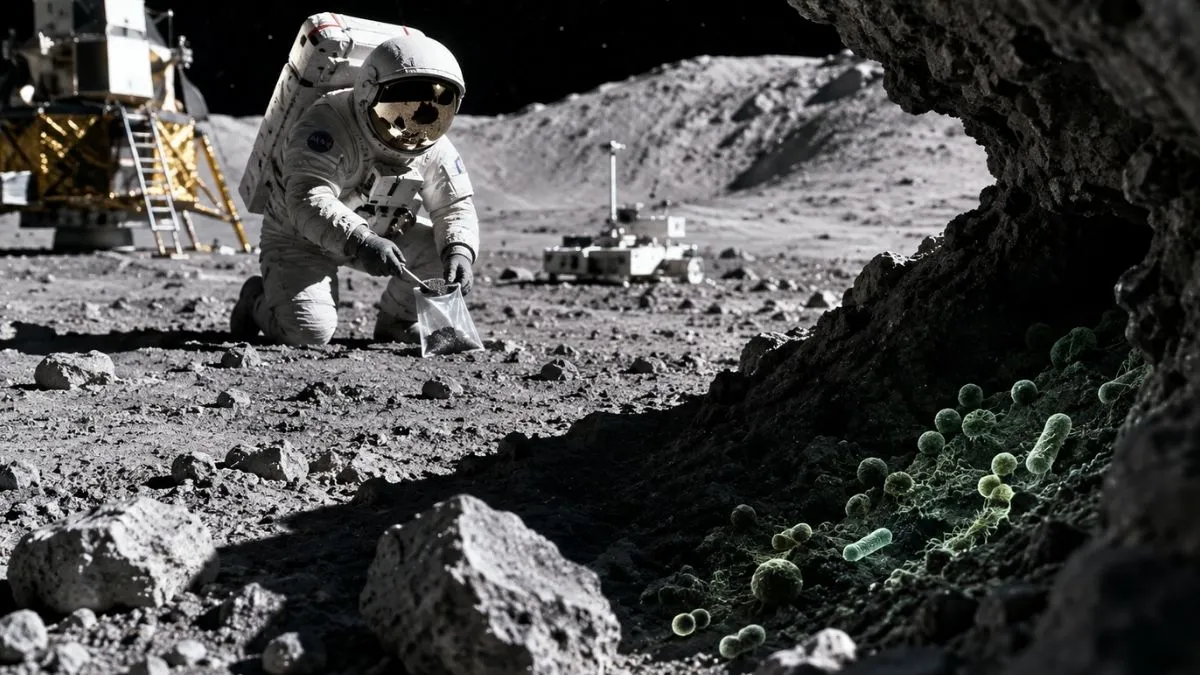
Lunar Contamination Threat: Microbes May Survive South Pole
"Skazimy Księżyc, zanim zdążymy go zbadać. Najgorszy koszmar badaczy. Skazimy Księżyc, zanim zdążymy go zbadać. Najgorszy koszmar badaczy."
Analiza
In 2026 the Artemis program is preparing permanent habitats near the Moon's south pole, a region where permanently shadowed craters preserve water ice. Recent simulations using Lunar Reconnaissance Orbiter topography, temperature and illumination data show that micro‑scale shadows can also shelter Earth‑origin microbes for months, even years. Bacterial species such as Bacillus subtilis, Staphylococcus aureus and the radiation‑resistant Deinococcus radiodurans were tested under lunar‑like vacuum, temperature swings and UV flux, revealing that the extreme cold and lack of atmosphere do not guarantee sterilisation. Human astronauts inevitably transport skin cells, gut flora and spores on clothing and equipment, creating a biological footprint that cannot be fully removed before launch. While robotic probes can be baked at over 200 °C, crewed missions cannot undergo such extreme decontamination, leaving a pathway for contamination. The convergence of harsh lunar conditions with protective geomorphology makes the south‑pole craters a hidden niche for terrestrial life, raising planetary‑protection concerns as commercial and scientific activities expand.
The discovery forces space agencies and private partners to rethink planetary‑protection protocols, potentially delaying habitat construction until robust sterilisation technologies are validated. It also opens a new market for advanced biocleaning systems capable of treating humans and habitats without compromising health. Failure to contain microbial transfer could jeopardise scientific studies of indigenous lunar volatiles and compromise the integrity of astrobiological experiments. Policy makers may introduce stricter quarantine standards, similar to those used for Mars, influencing budget allocations across the Artemis roadmap. In the long term, the episode highlights the need for an international framework governing biological contamination of celestial bodies, shaping the future of lunar commerce and exploration.
Komentarz Redakcji
InfoHub warns that the race to colonise the Moon may be racing ahead of basic bio‑security. Ignoring microbial hitchhikers could turn our greatest scientific triumph into a planetary‑protection nightmare.
ℹ️ Nota od wydawcy:
Powyższy nagłówek pochodzi z oficjalnych kanałów RSS.
Sekcje "Analiza" ,"Kontekst" oraz "komentarz" są generowane przez AI w celu przybliżenia tematu.
Polecane przez InfoHub
Zmień dostawcę na szybszego! Niezawodny Światłowód i TV w super cenie. Sprawdź najnowsze pakiety multimedialne.
Bądź na bieżąco! Wszystkie najlepsze promocje w jednym miejscu!!
🍪 Dbamy o Twoją prywatność
Używamy cookies m.in. do analizy ruchu i personalizacji. Kontynuując, zgadzasz się na nasz
Regulamin oraz
Politykę Prywatności.